- Crypto Saving Expert's Newsletter
- Posts
- Crypto Saving Expert Newsletter - Issue 185
Crypto Saving Expert Newsletter - Issue 185
GM.
Markets just got the green light.
Ceasefire headlines flipped the tone overnight… oil is dumping, equities are ripping, and risk is finally waking up.
Bitcoin?
Still hovering right at the edge.
So the question now is simple.
Is this the breakout we’ve been waiting 60+ days for…
Or just another fake move before the real one?
Let’s break it down. 👇
Table of Contents
Sponsored by: PrimeXBT

Markets are tense. Gold and silver are moving strongly while crypto remains range-bound.
This is why multi-asset trading matters. On PrimeXBT, you can trade gold, FX, indices, commodities, and crypto from a single account.
Exclusive community deal: 0 trading fees on the PXTrader platform - 20% trading bonus. No need to switch platforms
Sign up using the link to access this offer HERE
Markets Get The Green Light
Tuesday was a pivotal day for the world. But following the ceasefire agreement between the US and Iran, it is the markets that are already reaping the benefits.
Bitcoin
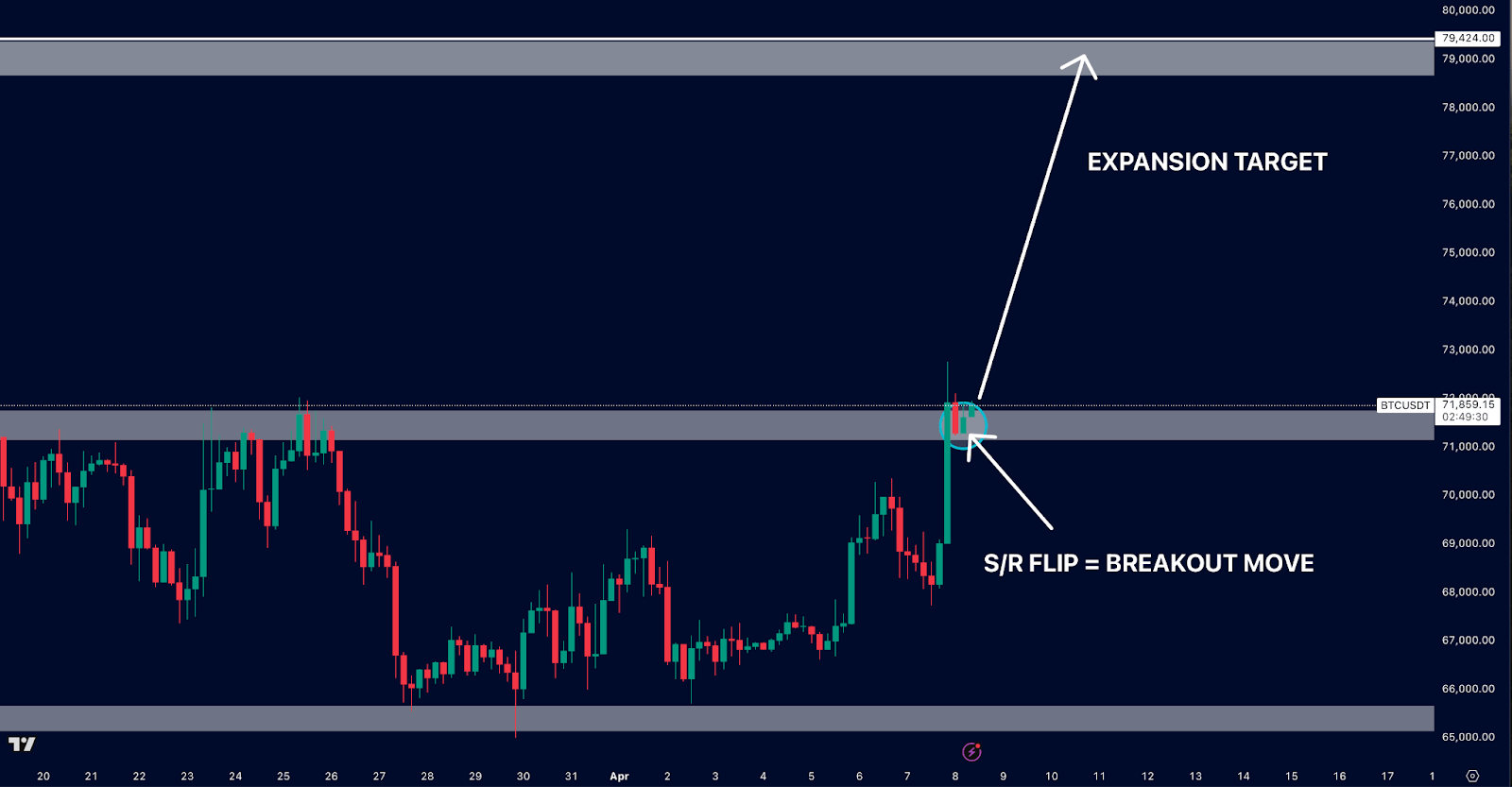
Bitcoin is on the cusp of breaking out in what has been a two-month wait for confirmation.
After 60+ days of remaining idle, the potential for a volatile, expansive move is real and it could see strength and momentum return to bitcoin for the first time in months.
The area of $79,000 has long been the initial target of a breakout that we have looked at in this newsletter, with this move potentially being the key.
Ethereum
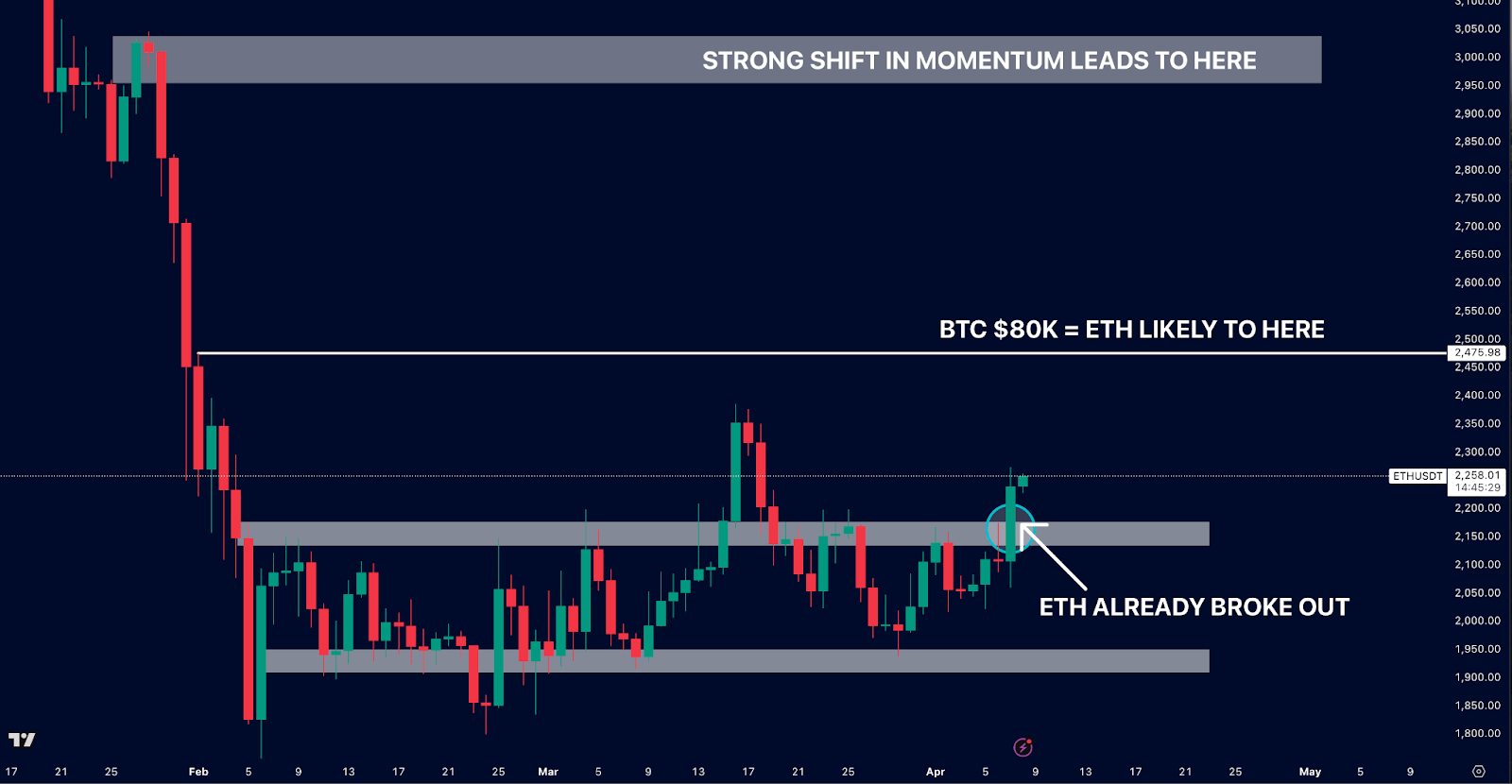
Ethereum has already broken its range and is bursting to the upside strongly.
This is seeing ETH move towards its March high, and the idea of a $2,500 price tag does not seem that far away.
In reality, the theory of $80,000 BTC and $2,500 ETH may even be conservative given its strength this week.
Still, until the market proves itself, conservatism may be the best method.
S&P 500
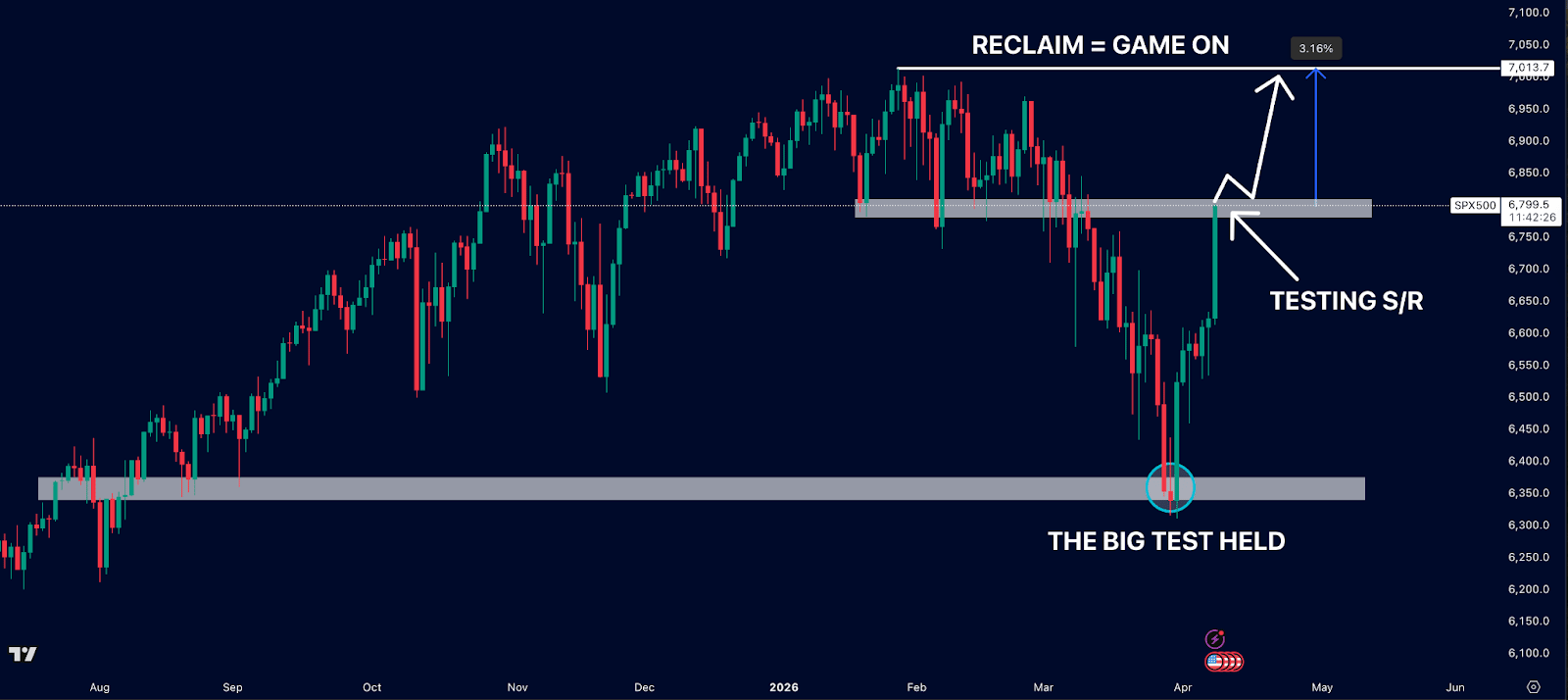
The S&P 500 has retraced almost all of its downside move from March.
The big test came in late March into April as it tested demand down at the $6,350 S/R region.
We can now see this provided the origin of this bounce and the S&P is seeing a monster daily candle on the back of the ceasefire agreement.
If it can recapture support at $6,800, then the move to new highs is a short one and a potential reality even this month.
Tariff crash 2.0?
Oil
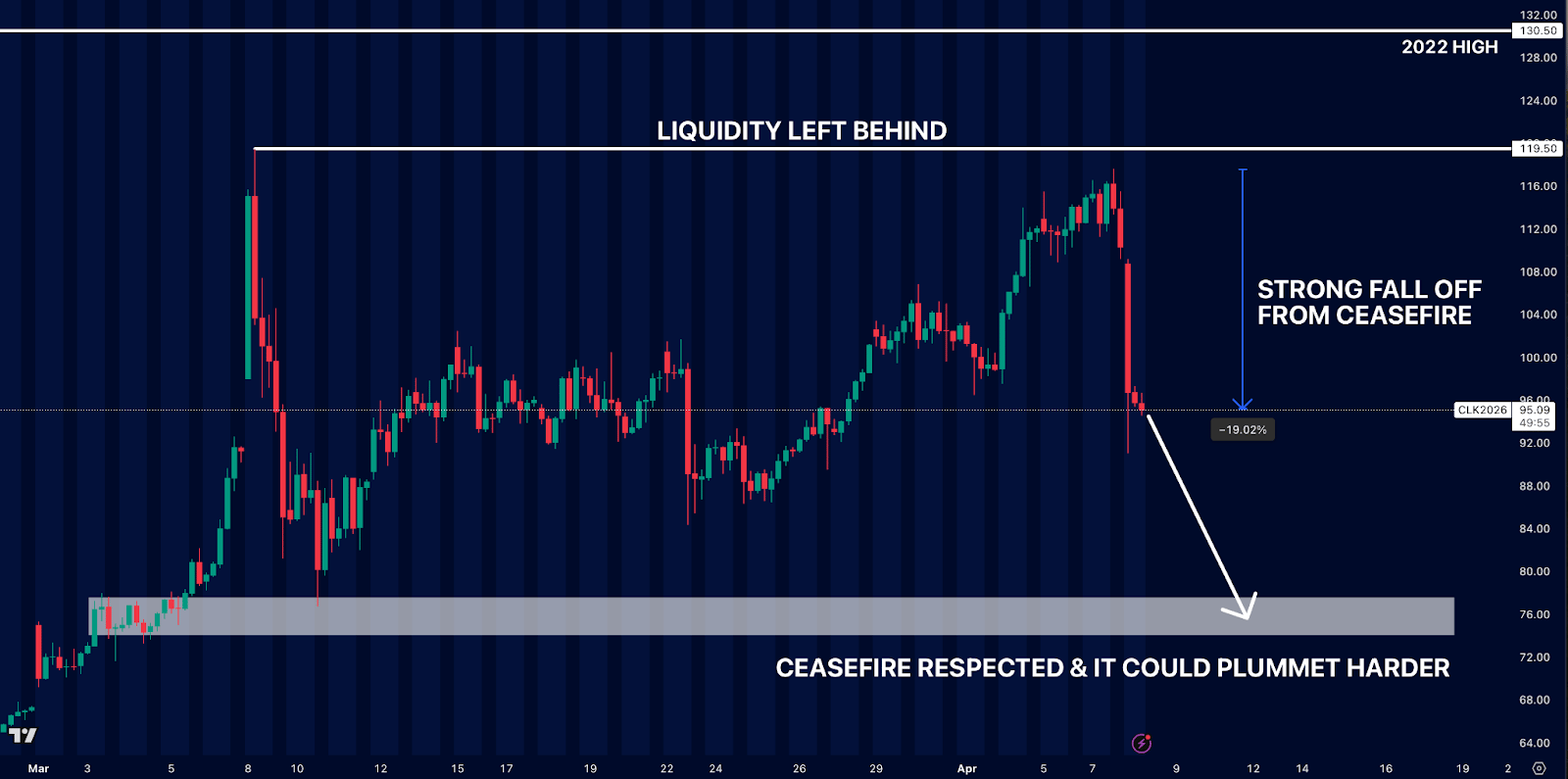
Oil is the biggest loser in all of this, seeing -15% on the day and almost 20% down from Tuesday’s high.
Again, catalysed by the ceasefire between the US and Iran.
If the ceasefire is respected for the full two weeks, it gives plenty of runway for risk markets like crypto and stocks to rally while oil tumbles.
The area of $76 could be revisited during this time as oil supply returns to normal across the globe.
Fear And Greed Index
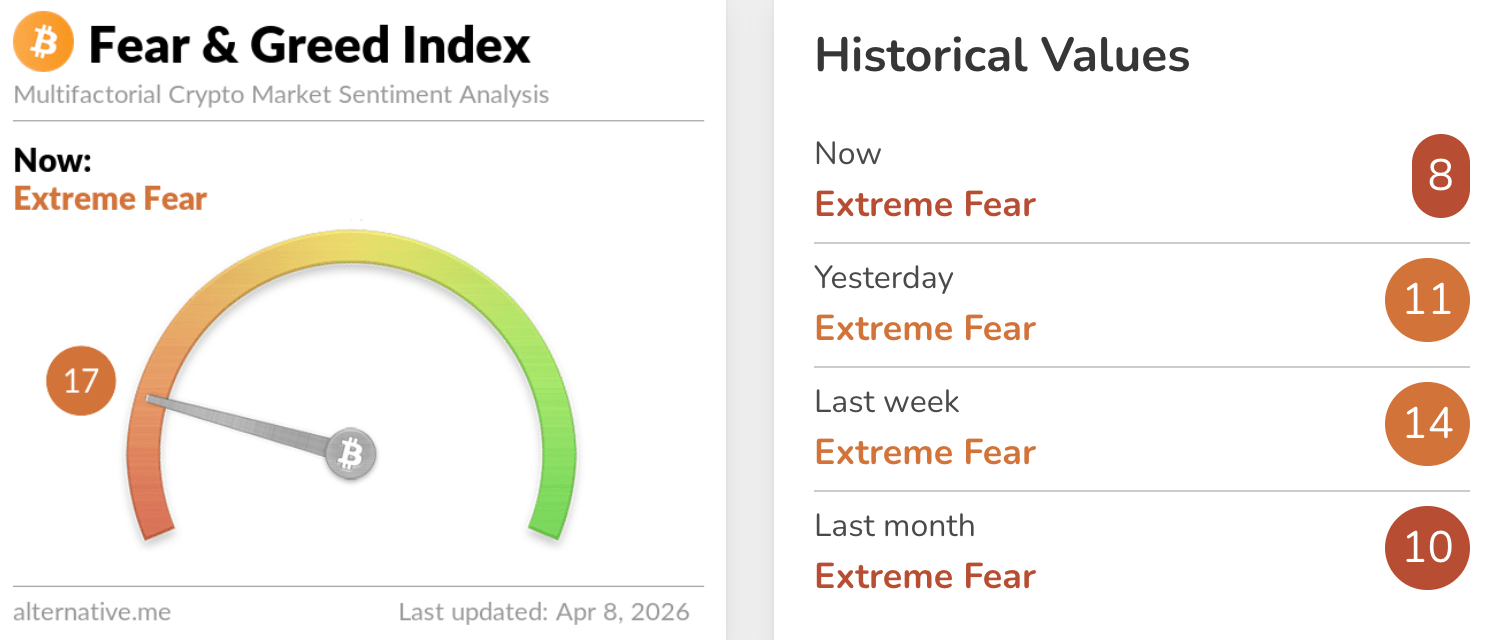
The Fear and Greed Index remains in Extreme Fear at 17.
However, the index is likely to see an uptick if bitcoin’s current move is the start of a breakout.
This could see the index gain traction as sentiment lifts, particularly if bitcoin heads towards $80,000.
Important Dates
Wednesday 8 April, 18:00 UTC - FOMC Minutes
The minutes from the Fed’s FOMC meeting in June will be released. This will provide a deeper insight into what was discussed in the meeting, alongside the tone of the comments.
Thursday 9 April, 12:30 UTC - Core Personal Consumption Expenditures (PCE)
The US Bureau of Economic Analysis releases the core PCE data, which measures the average amount of money consumers spend monthly in the economy.
PCE is released in two formats: month-over-month and year-on-year. The data also removes volatile products, such as energy and food.
The year-on-year data is forecast to come in at 3%, with the previous data at 3.1%.
Friday 10 April, 12:30 UTC - US Consumer Price Index (CPI)
CPI measures inflation and is a vital economic measurement in all countries. The data is released by the Bureau of Labor Statistics and calculated using a shopping basket of goods and services.
The data is forecast at 3.3%, with the previous data lower at 2.4%.
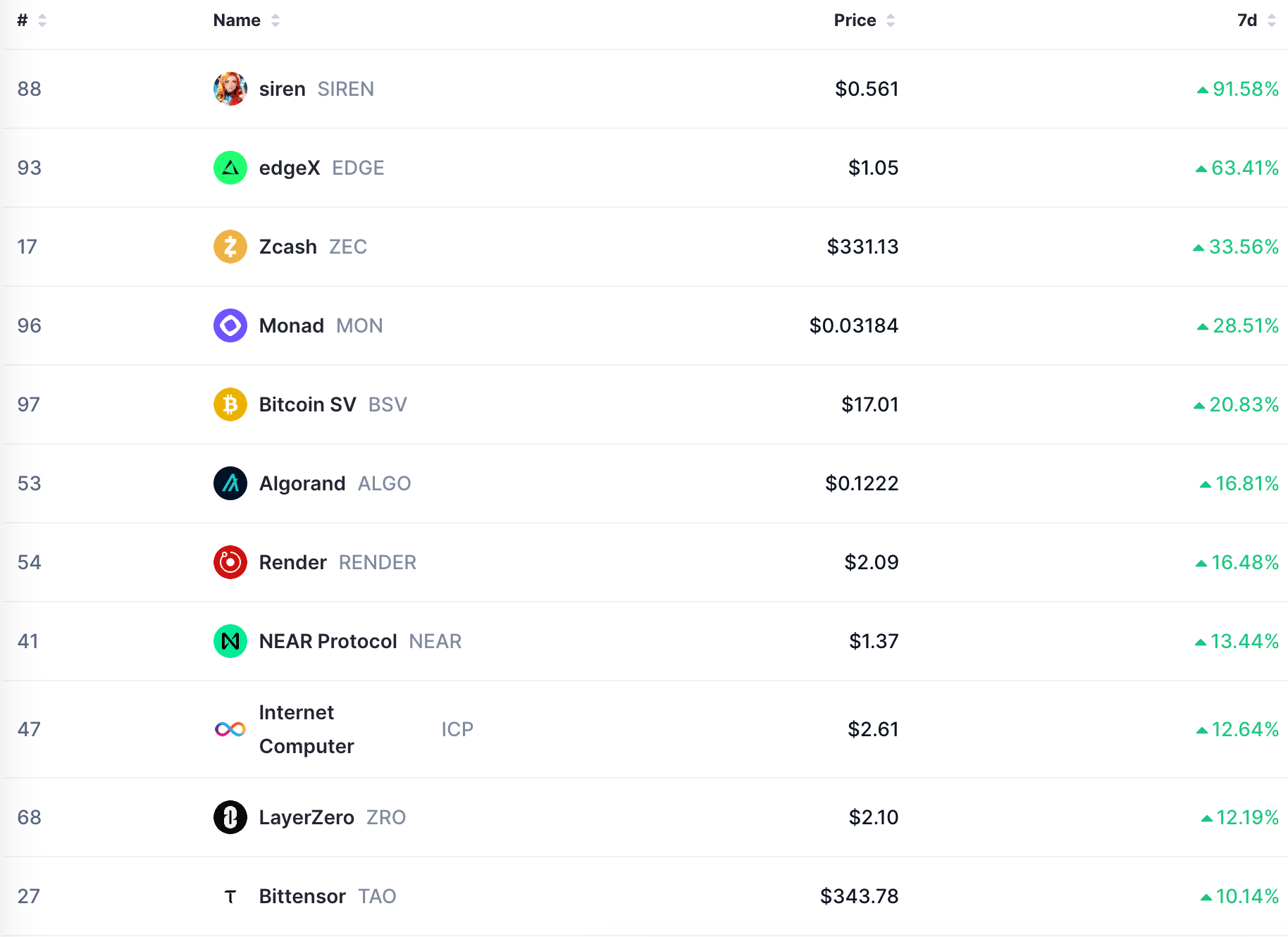
Gainers
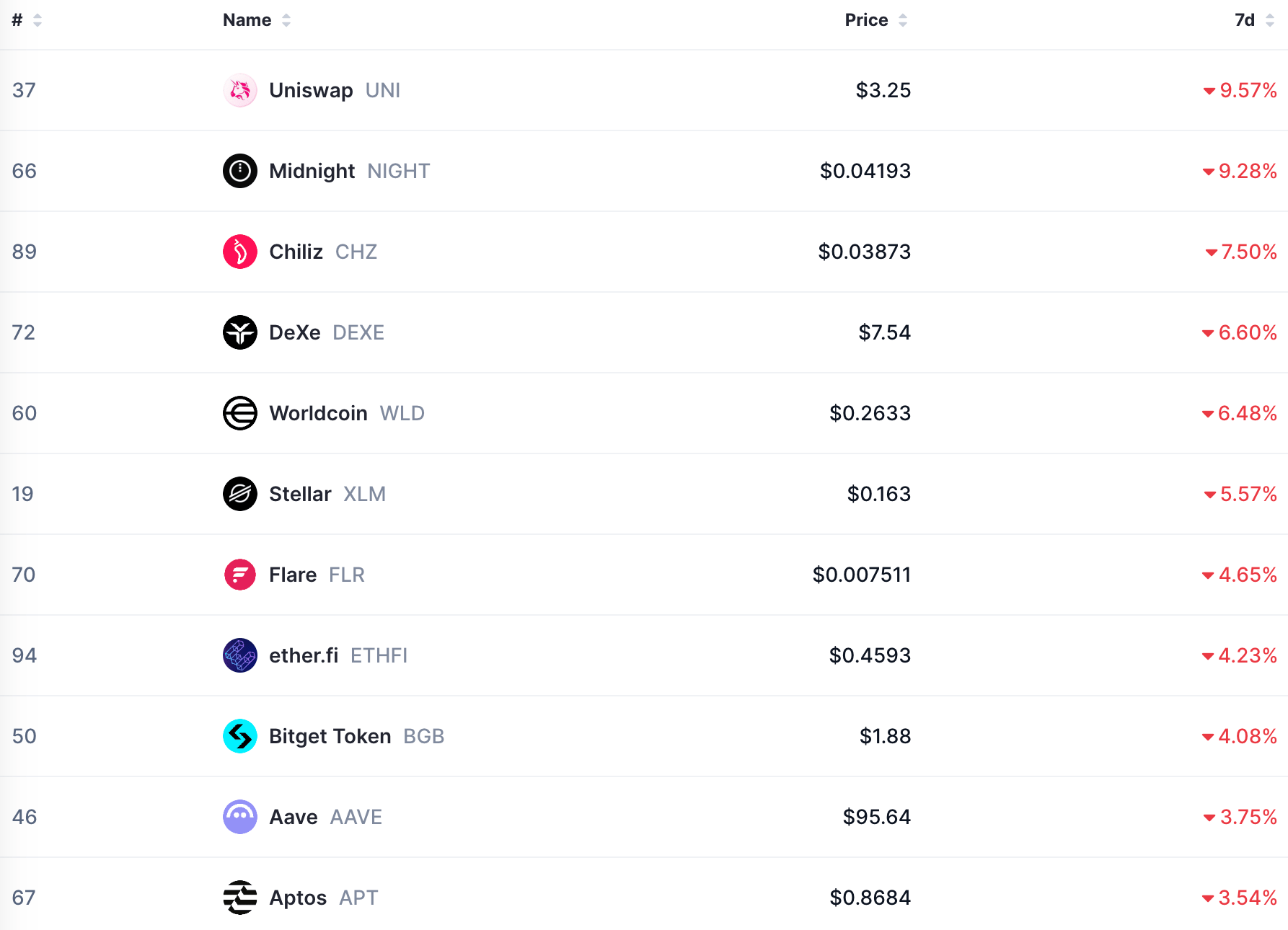
Losers
Drift Hack Was a Six-Month Infiltration Linked to a North Korean Group
The $285m Drift Protocol exploit has been linked to a North Korean hacking group following a months-long social engineering campaign.

The $285m Drift exploit wasn’t a bug, it was a setup.
Drift Protocol has revealed that its April 1 hack was the result of a six-month infiltration campaign, not a sudden technical failure. The Solana-based derivatives platform said attackers gradually embedded themselves into the project before draining up to $285m in just 12 minutes.
The attack has been attributed with medium-to-high confidence to UNC4736, a North Korean state-affiliated hacking group also known as AppleJeus or Citrine Sleet, the same group previously linked to the Radiant Capital exploit in 2024.
According to Drift, the attackers began targeting the project as early as autumn 2025, using a mix of social engineering tactics to gain trust and access.
They reportedly posed as legitimate quantitative trading firms, met contributors at real-world crypto conferences and distributed malicious software disguised as tools and libraries.
Over time, this allowed them to gain deeper access to internal systems before escalating privileges and executing the final exploit.
By the time the attack happened, they were already inside.
$285m drained in minutes
On April 1, the attackers struck, emptying a major protocol vault in roughly 12 minutes. The speed and precision of the exploit suggest extensive preparation and testing beforehand.
On-chain analysis has since linked early test transactions to wallets associated with the previous Radiant Capital hack, reinforcing the connection between the two incidents.
Drift has since frozen parts of the protocol, removed compromised wallets from its multisig setup and brought in external investigators, including cybersecurity firm Mandiant.
Part of a much bigger pattern
The incident is unlikely to be isolated.
Security researcher Taylor Monahan noted that North Korean-linked operatives have infiltrated more than 40 DeFi platforms over the past seven years, often using similar long-term tactics.
Rather than relying solely on smart contract vulnerabilities, these campaigns focus on human entry points, trust, relationships and access.
The code wasn’t the weakest link. People were.
The takeaway
The Drift exploit underscores a growing shift in crypto security threats.
As protocols harden their code, attackers are increasingly targeting the teams behind them, turning hacks into months-long operations rather than single points of failure.
And in this case, the breach was already complete long before the funds were taken.
Sources
Drift Protocol: Official incident disclosures (April 2026)
Mandiant: Cybersecurity investigation involvement
On-chain analysis linking the Radiant Capital exploit (2024)
Taylor Monahan: DeFi infiltration research
Crypto Scammers Falsely “Kill” World’s Oldest Tortoise in Viral Hoax
A fake X account sparked global headlines after falsely claiming the death of Jonathan, the world’s oldest tortoise, in a crypto scam attempt.
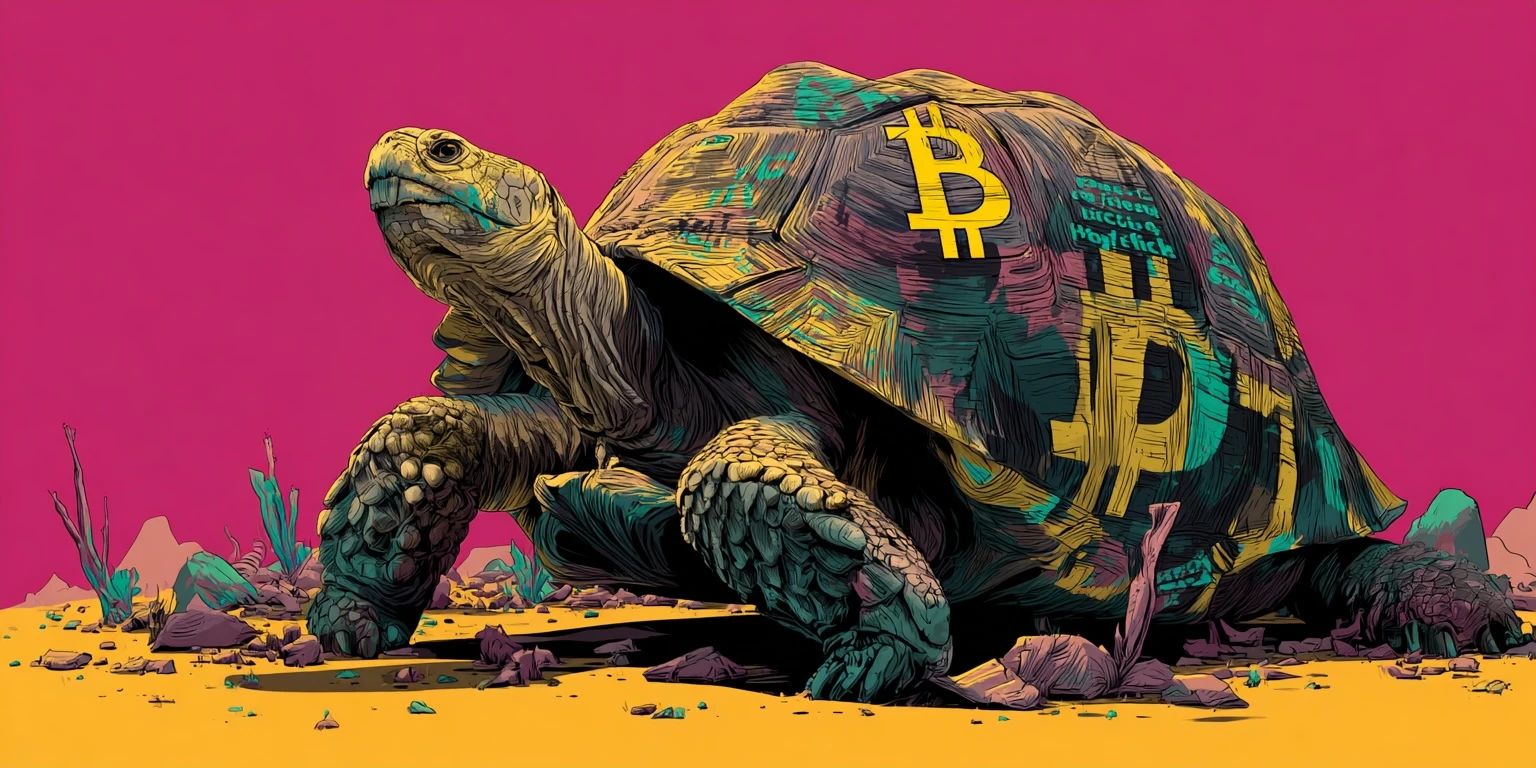
Even a 194-year-old tortoise isn’t safe from crypto scams.
Jonathan, the world’s oldest known land animal, https://www.theguardian.com/world/2026/apr/03/jonathan-tortoise-crypto-scam dead this week after a fake X account impersonating his veterinarian spread the news — before attempting to solicit cryptocurrency donations.
The post, attributed to a supposed “Joe Hollins”, claimed the giant Seychelles tortoise had “passed away peacefully” on the island of Saint Helena. The emotional message quickly went viral, racking up millions of views and being picked up by major outlets including the BBC, Daily Mail and USA Today.
There was just one problem.
Jonathan was still very much alive.
From tribute to scam
The account behind the post was later identified as being based in Brazil, with the real veterinarian, who does not use X, confirming the story was entirely false.
“Jonathan the tortoise is very much alive,” Hollins said. “The person purporting to be me is asking for crypto donations. It’s a con.”
The impersonator had indeed been requesting cryptocurrency at the time the story began spreading, turning what appeared to be a heartfelt tribute into a classic scam playbook: emotional hook first, financial ask second.
The BBC later retracted its report.
A very alive national icon
Jonathan has lived on Saint Helena since 1882 and is believed to be at least 194 years old, having already been alive when Queen Victoria took the throne.
The tortoise is something of a local celebrity on the remote South Atlantic island, even appearing on the reverse of its 5p coin.
When news of his supposed death broke, Governor Nigel Phillips was inundated with messages and went out in the night to check on him personally.
He found Jonathan exactly where you’d expect.
Asleep under a tree.
Proof of life, with an iPad
To shut down the rumours, officials released a photo the following morning showing Jonathan alive and well, posed next to an iPad displaying the BBC homepage.
The tortoise, who is blind from cataracts and has lost his sense of smell, appeared largely unbothered by the global panic.
He continues to spend his days grazing, basking in the sun and, according to caretakers, attempting to mate with younger tortoises on the property.
In celebration of his “resurrection”, Jonathan was given a double helping of his favourite snack: bananas.
The bigger picture
While the story ended harmlessly, it highlights a growing trend of crypto-related scams leveraging social media impersonation and viral misinformation.
By exploiting emotional narratives and trusted identities, scammers are able to spread rapidly, often faster than verification can catch up.
In this case, even major media outlets were briefly fooled.
And if a 194-year-old tortoise isn’t off limits, nothing is.
Morgan Stanley Bitcoin ETF Set to Launch on NYSE Arca
Morgan Stanley is launching its Bitcoin ETF on NYSE Arca, marking the first major US bank to enter the spot BTC ETF market.

Wall Street is going deeper into Bitcoin.
Morgan Stanley is set to launch its Bitcoin exchange-traded fund on NYSE Arca on April 8, marking the first time a major US commercial bank has brought a spot Bitcoin ETF to market.
The product, named the Morgan Stanley Bitcoin Trust (MSBT), was confirmed in a listing notice by the New York Stock Exchange, signalling its official debut.
The launch comes nearly two years after the last new entrant to the spot Bitcoin ETF market, with Grayscale’s Bitcoin Mini Trust debuting in July 2024.
Entering a crowded battlefield
Morgan Stanley is stepping into an already competitive arena dominated by BlackRock and Fidelity.
BlackRock’s iShares Bitcoin Trust and Fidelity’s Wise Origin Bitcoin Fund have collectively attracted more than $74bn in net inflows since launching in early 2024, establishing a clear lead in the market.
MSBT will need to differentiate quickly.
The bank appears to be doing that on price, setting a management fee of just 0.14%, one of the lowest in the sector and a move that could pressure competitors to respond.
Fee wars may be about to intensify.
The real advantage: distribution
While Morgan Stanley is late to the ETF race, it brings something few competitors can match: distribution.
Bloomberg ETF analyst Eric Balchunas highlighted the bank’s reach, noting that it has around 16,000 financial advisors overseeing roughly $6tn in client assets.
That network could act as a powerful channel for Bitcoin exposure, particularly among traditional investors.
In ETF markets, access often matters more than timing.
Crypto push accelerating
The ETF launch is part of a broader expansion into digital assets by Morgan Stanley.
Earlier this year, the bank applied for a national trust banking charter that would allow it to custody crypto assets, execute trades and offer staking services to clients.
It has also filed to list additional crypto products, including a staked Ether ETF and a Solana ETF, signalling ambitions well beyond Bitcoin.
To support that push, Morgan Stanley appointed long-time executive Amy Oldenburg to lead its digital asset division in January.
This isn’t a one-off product launch, it’s a strategy.
The bigger picture
The arrival of MSBT reinforces a broader trend: traditional finance is no longer testing crypto, it is integrating it.
With BlackRock, Fidelity and now Morgan Stanley all competing in the same space, Bitcoin ETFs are increasingly becoming a core part of institutional portfolios.
The question is no longer whether banks will adopt crypto.
It’s how aggressively they’ll compete for it.
Sources
NYSE Arca listing notice https://www.nyse.com/index
Farside Investors — ETF flow data https://farside.co.uk/?p=997
Eric Balchunas commentary https://twitter.com/EricBalchunas


We’re excited to offer you a massive 35% discount!
What You Unlock:
- Strategies from top crypto experts
- Exclusive access to market insights, guides, and top tips
- Tools to maximise your crypto savings and investments
- A supportive community of like-minded crypto enthusiasts
- Access to our community Discord
Use the code 35OFF at checkout to claim your discount and get full access to our community plan for just a fraction of the price.
Secure your spot in the Crypto Saving Expert Community today.
Sponsored by: Stonksy

Stonksy is a momentum identifier that aims to capture expansive market moves before they happen by highlighting the start of potential price shifts. It can be used across all markets, including crypto, stocks, indices, commodities, and currencies.
Stonksy is growing in users week-on-week, proving why it aims to become one of the most-used indicators in the industry.
You can get 25% off the annual Stonksy plan with code TMG25, taking the price down to just £749.25 for an entire year of full access. Sign up here.
Find examples of Stonksy indications posted to the X every day: @stonksyio and learn how to use Stonksy and how it can benefit your trading system on the YouTube channel, with daily livestreams at 12:00 UTC.
This Newsletter is strictly for informational purposes only; the content is generic and has not been tailored in any way. Crypto Saving Expert UAB (“CSE”) is not providing, and should not be interpreted as providing, any form of offer of any currency, security, financial instrument or digital asset, or investment advice, recommendations or strategy. The content of this Newsletter is not intended to replace your own research with regard to any assets, products or services, and any action taken on the basis of this material is entirely at your own risk. CSE neither accepts nor assumes any liability or responsibility for any loss or damage arising out of, or in any way connected to, the Newsletter content. Cryptocurrencies and digital assets may be unregulated in your jurisdiction, any profits may be subject to tax and the value of any investment could fall.
If you click on a link within this Newsletter to go through to a provider, we may get paid. This usually only happens if you get a product/use a service from it. This is what helps fund CSE and keeps the majority of our content free to use. Two crucial things you should know about this, however: a) this never impacts our editorial recommendations, if something is included, it is because we independently rate it as the best; and b) you will always get as good a deal, or better, than if you went direct. For full details on how CSE is funded, please click here.
CSE collects, processes and stores certain data. Such data may be shared with CSE’s wholly owned subsidiary company, Crypto Saving Expert Limited. Please note that by submitting information about yourself to CSE you are consenting to such use. For full details on our collection, processing and storage of data, together with your rights in relation thereto, please consult our Privacy Statement here.
Social engineering over smart contract exploits